Care Is Infrastructure (Again) ~via Denise Barreto
I met Denise 15 years ago when she was working at Sears, and few people I have encountered in my business travels care more deeply about others or work harder to make the systems around us serve people better. In this piece, she makes a compelling case that child care, elder care, and community care are not simply private concerns… they are essential infrastructure, and when those systems fail, families, employers, and entire cities pay the price. /Ted
Funny how that works.
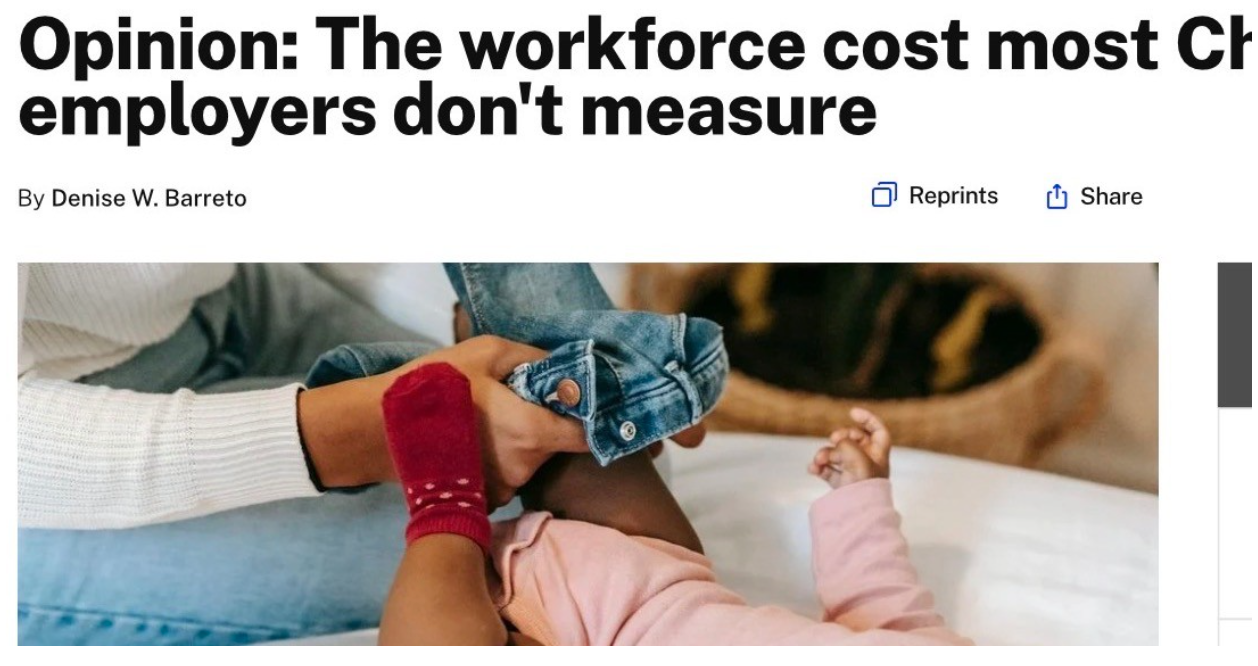
Crain’s Chicago Business ran this piece two days after I submitted it. Then the week I released Built For Us All to the world, it vanished.
Not moved.
Not archived.
Gone — like it never existed.
Search my name on their site and you’ll find plenty of me. This piece? Nowhere.
I reached out to the editor to ask what happened, citing potential technical difficulties. Still waiting on an answer
Good thing I keep receipts.
So here it is — word for word — because care being infrastructure doesn’t stop being true just because a masthead got uncomfortable with who was saying it, and why. This is the same reason I self-published the Bears/Michael Reese piece a few weeks ago: if they won’t tell the full story, we will.
I’m not asking Crain’s for anything. I don’t need them to run my words. I need people to read them.
Share this if you believe care is infrastructure.
Original published February 4, 2026
When a city fails to plow its streets after a major snowstorm, Chicago employers understand the consequences immediately. Employees arrive late or not at all. Deliveries are delayed. Meetings are canceled. Productivity drops. No one treats this as a personal failure by workers. It’s recognized for what it is: an infrastructure disruption with real economic costs.
But when child care suddenly falls through — because a provider closes, a caregiver quits, or a l school dismisses early due to extreme cold — the resulting disruption is framed very differently. The employee who can’t make it to work is seen as dealing with a private issue, even though the impact on the business is often the same.
That distinction is increasingly difficult to justify in today’s labor market.
Care failures function like infrastructure failures. We just don’t account for them that way.
Modern economies depend on systems that allow people to reliably show up for work. Transit networks, roads, utilities and digital infrastructure all exist to reduce friction between workers and jobs. When those systems fail, employers feel the effects immediately.
Care systems — child care, after-school programs, community care and elder care — serve the same function. They are the connective tissue between households and the labor market. When they work, workforce participation is possible. When they don’t, absenteeism, turnover and reduced hours follow.
In Chicago, this dynamic is especially visible during Chicago Public Schools cold weather closures. When sub-zero temperatures force CPS to cancel classes or emergencies cause local schools to dismiss students early, thousands of working parents are suddenly left without child care in the middle of the workday. Meetings are missed. Shifts go uncovered. Employees log off unexpectedly or don’t show up at all. Yet the resulting workforce disruption is still treated as an individual problem rather than what it is: a predictable infrastructure gap with real economic consequences.
A single child care disruption can ripple through a workplace in hours. A parent leaves early. A shift goes uncovered. A deadline slips. Multiply that across teams and weeks, and what looks like a personal challenge becomes an operational one.
Elder care failures are even more destabilizing. They often arrive without warning: a fall, a health emergency, a caregiver who doesn’t return. From an employer’s perspective, these events behave less like planned leave and more like sudden outages — unpredictable, prolonged and difficult to absorb.
For years, companies have absorbed the costs of care instability indirectly. Lost productivity, higher turnover, stalled advancement and increased recruiting expenses are often chalked up to vague “labor challenges.” But underneath many of these issues is the same structural weakness: care systems that are fragmented, underfunded and unreliable.
The burden falls disproportionately on women, but the costs land squarely on employers. In a tight labor market, where experienced workers are hard to replace and institutional knowledge matters, these losses are not marginal. They are expensive and largely avoidable.
That’s why recent developments in New York should matter to Chicago’s business community.
On Jan. 8, New York City Mayor Zohran Mamdani, working in partnership with New York Gov. Kathy Hochul, moved quickly to secure multiyear state funding to launch universal child care in the nation’s largest city. Much of the public attention has focused on affordability and family relief. But for employers, the implications are more immediate and practical.
Reliable child care increases workforce stability. It reduces unplanned absences. It keeps skilled employees, particularly mid-career workers, in the labor market. And it does so without requiring businesses to shoulder the full cost of care solutions on their own. Many employers already recognize this and supplement and subsidize care today. Public investment creates predictability, the same condition businesses look for before making long-term plans. When care systems are treated as infrastructure rather than personal arrangements, employers gain a more dependable labor supply almost overnight.
This isn’t a long-term social experiment. It’s an operational upgrade.
Chicago businesses already rely on public infrastructure they didn’t build themselves. Roads, transit systems, airports and power grids all fall into this category. Care systems have simply been excluded from that framework, even though their failure produces the same kinds of disruptions.
As demographics shift and caregiving demands increase, that exclusion becomes harder to justify. Cities and regions that recognize care as workforce infrastructure will be more competitive. Those that don’t will continue paying the hidden costs of instability.
When streets aren’t plowed, no one blames workers for staying home. When trains don’t run, no one questions whether transit counts as infrastructure. The effects are visible, measurable and widely understood.
Care failures produce the same outcomes — just without the same recognition.
The question for Chicago employers is not whether care should be considered infrastructure. It already functions that way. The real question is whether businesses will continue absorbing these costs quietly or begin treating care systems with the same seriousness as the infrastructure they already depend on.