Your next customer might be an algorithm. Who's accountable for it? ~via Dean Landsman
I’ve had the honor and pleasure of knowing Dean Landsman (thanks to Isabel Walcott Draves), and being mentored by him in the digital space, for over 20 years. Dean is the one who, in 2009, insisted I start a blog and start publishing about RETURN ON RELATIONSHIP on more platforms than just Twitter.
The moment I keep coming back to in this post is what happens when a purchase goes wrong. A customer should be able to see what they authorized, what the agent actually did, and who can put it right.
That’s where I see RETURN ON RELATIONSHIP in all of this. An AI agent may handle the checkout, but how the brand shows up when someone needs help is what that person will remember and share. -Ted
"Your next customer might be an algorithm." That's one of the themes the IAB (Interactive Advertising Bureau) has set for its Annual Leadership Meeting. Another: "The shopper isn't always the one checking out."
Both point to the same problem. When an AI agent finds a product, picks it and pays for it on someone's behalf, a basic question gets hard to answer: who actually said yes?
Behind that sits a bigger question. Every AI agent let loose on the internet, whether it's buying, booking, negotiating or signing, should answer to a real person. Not an account. Not an API key. To a verified human who authorized it to act, agreed to what it's allowed to do, and owns the outcome. Today, very few agents can prove that.
With colleagues at JLINC, Vconic and Inlayer I’ve been working on exactly this: who said, did or authorized what, and how can we be sure? Next week in Washington, D.C., we'll present our answer.
What the IAB is watching
Discovery is changing hands. Your next customer might be an algorithm.
Commerce is getting rewired. The shopper isn't always the one checking out.
Streaming is getting smarter. Supply path optimization is out; supply path intelligence is in.
Creators are part of the AI journey. They aren't just in the feed anymore. They're the answer.
A word to my friends in the personal data and internet identity worlds who look at the IAB with suspicion: I don't think advertising is the enemy. Running and owning radio stations taught me that advertising can be informative, entertaining, even captivating, and often necessary. Some of it is invasive, and I'll say so. But the IAB is asking the right questions.
Every agent needs an accountable human
An agent that spends money, signs up for a service or makes a commitment is acting on someone's authority. In the physical world we've always had ways to tie an action to a person: a signature, a face at the counter, a voice on the phone. Agents break that link. They act fast, at scale, and often while the person who launched them is asleep.
That creates real exposure. If a purchase is disputed, who's on the hook? If an agent goes beyond what it was told to do, who approved it? If a bad actor spins up a thousand agents, how does a merchant tell them apart from legitimate ones?
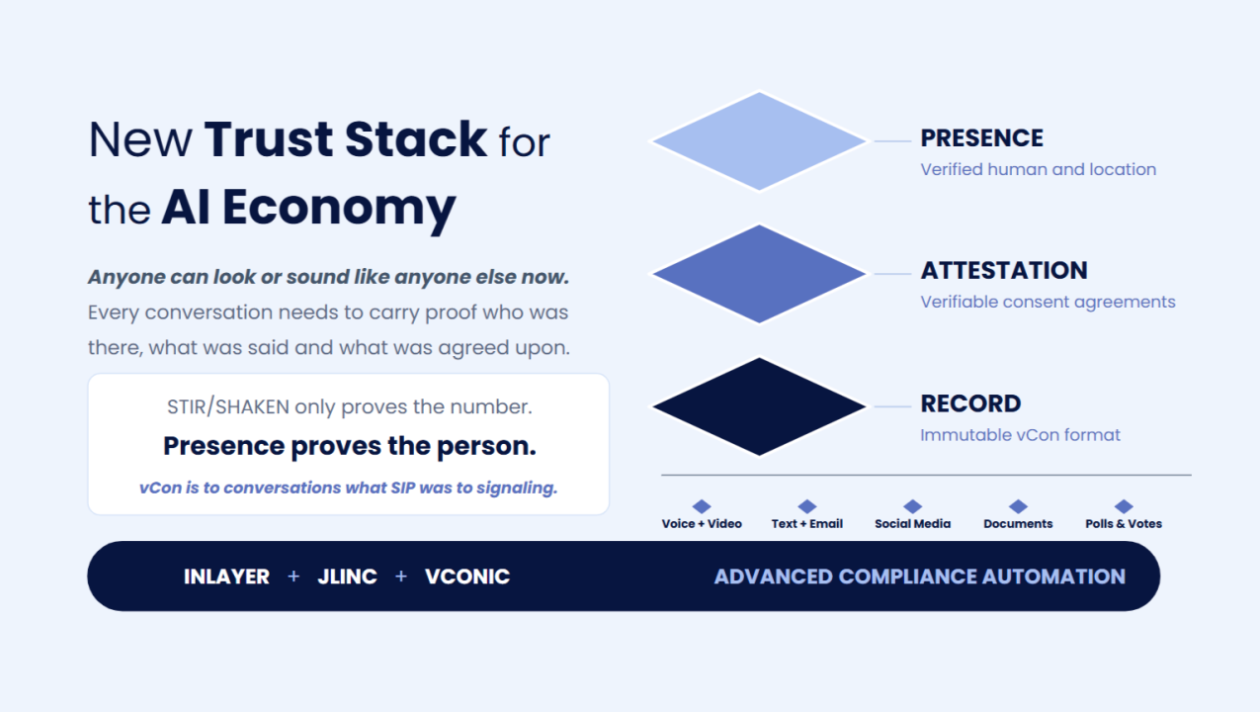
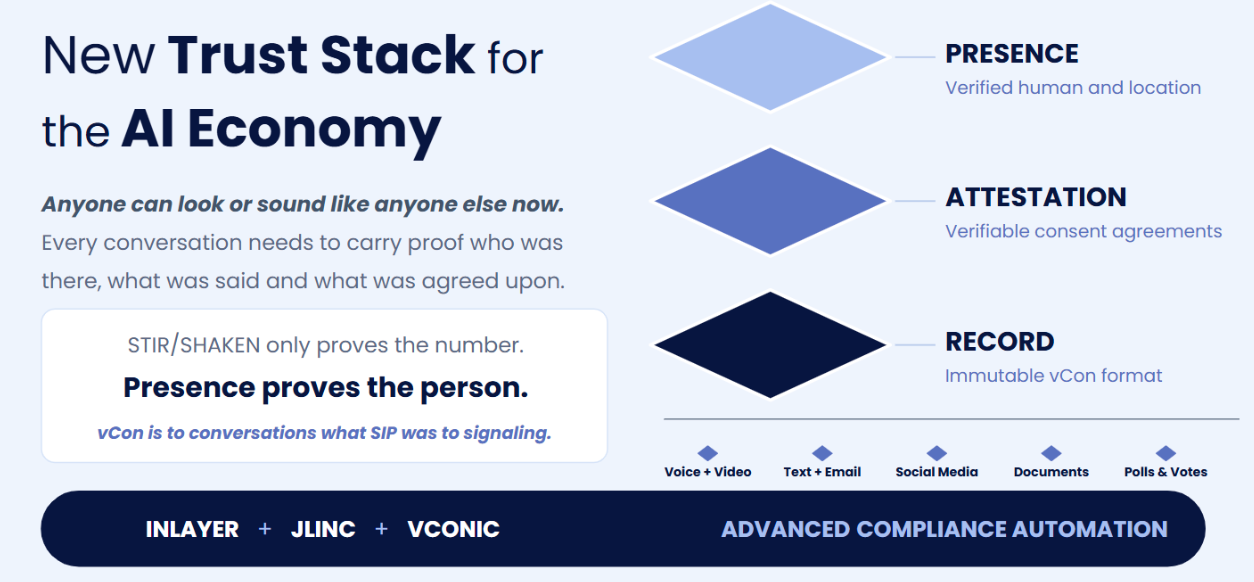
The answer starts with three things every agent should be able to prove. A real human stands behind it, not a bot vouching for another bot. That person authorized it and consented to what it's allowed to do. And there's a record of both that holds up when someone asks later.
That's accountability. Without it, "the shopper isn't always the one checking out" quickly becomes "nobody knows who checked out."
Why attestation matters now
As we increasingly rely more on AI, and in some cases depend on it completely, recording what happened becomes essential. Sometimes it's a compliance requirement. Sometimes it's as simple as an internal review: "How did we come to that?" And "that" might be a price, a strategy, a color, a bonus, a financial transaction, or a medication dosage.
That's where our three companies come in:
● JLINC is the attestation layer, an independent third party. Assuring provenance with a cryptographic proof, it stores the record and never looks at it unless asked. Think of it as business protection insurance.
● Presence by Inlayer provides verifiable proof that a real human was present, that they are who and where they claim to be, and proof that they authorized the AI to act on their behalf.
● Vconic provides the vCon, the container that holds the full record and makes the whole thing work technically.
It's a one-two-three punch.
See it in D.C. on December 2
Next week Jeff Pulver hosts this year's vCon Foundation Policy meeting in Washington, D.C. I'll be there with my JLINC colleague Darius Dunlap. On the afternoon of December 2, James L. Lee (CEO, Inlayer) and Thomas McCarthy-Howe (CTO, Vconic, and co-creator of vCons) will join me to present The Trust Layer, the product we introduced last month at VON Voice/AI in Atlanta.
If you'll be at the meeting or in the D.C. area, reach out and let's find a time to meet.