
1 in 3 Americans Want to Start a Business This Year. Here’s What’s Actually in the Modern Founder’s Tech Stack. ~via Jay Thornton
Jay… “here’s what I know from watching hundreds of founders get started: the tools have never been better, but the overwhelm has never been worse.”
If you are thinking of starting a business, don’t miss this one from Jay Thornton… who’s been there, done that, several times… and knows tech and creative for start-ups. -Ted
One in three Americans plan to start a business this year.
That’s not my number. That’s from Intuit QuickBooks’ 2026 Entrepreneurship Report-a survey of 3,000+ U.S. adults that found entrepreneurial intent has jumped 94% year-over-year.
Let that sink in. Nearly a third of the country is thinking about starting something.
I’ve been building software for small businesses for a while now. Mike and I launched LeadMachine specifically for teams who are tired of CRMs that feel like they were built for Fortune 500 companies. So when I see numbers like this, I pay attention.
Because here’s what I know from watching hundreds of founders get started: the tools have never been better, but the overwhelm has never been worse.
The Tool Sprawl Problem Nobody Talks About
The QuickBooks report highlights something I see constantly: money is the #1 barrier to starting a business. 47% of aspiring entrepreneurs cite cost as their biggest obstacle.
But here’s what I think is the hidden second barrier: decision fatigue from too many options.
Think about what a new founder faces in 2026:
Payment processor? Stripe, Square, PayPal, Shopify Payments, dozens of others
Website? WordPress, Webflow, Squarespace, Wix, Framer, Carrd
Email marketing? Mailchimp, ConvertKit, Klaviyo, Beehiiv, dozens more
CRM? Salesforce, HubSpot, Pipedrive, Monday, Close, Copper, Freshsales…
Scheduling? Calendly, Cal.com, SavvyCal, TidyCal
Analytics? Google Analytics, Plausible, Fathom, Mixpanel
Each category has 10-50 options. Each option has multiple pricing tiers. Each pricing tier has feature matrices that require a PhD to decode.
I’ve watched founders spend weeks picking tools before they’ve talked to a single customer.
That’s not a tooling problem. That’s a paralysis problem.
The Founders Who Win Aren’t Tool Maximizers
After watching a lot of early-stage businesses, I’ve noticed a pattern.
The founders who gain momentum fastest aren’t the ones who pick “best in class” for every category. They’re the ones who pick tools that work together and then forget about them.
Fewer dashboards. Fewer logins. Fewer integration headaches. More time on actual work.
The best founder tech stacks I’ve seen share three things:
1. Native integrations instead of Zapier duct tape
Every third-party connection is a potential point of failure. When your payment processor talks directly to your CRM without a middleman, things just work. When you’re routing data through three different tools to get information where it needs to go, things break-usually at the worst time.
2. AI that’s built in, not bolted on
This is a big one for 2026. The QuickBooks report found that 65% of aspiring entrepreneurs plan to use AI to help launch their businesses. But there’s a difference between using ChatGPT in a separate browser tab and having AI built into your actual workflow.
An AI CRM that researches your leads automatically is different from a CRM where you have to copy-paste into a separate AI tool and then copy-paste back.
3. Flat pricing you can predict
When you’re starting out, surprise bills kill cash flow. I’ve seen founders get hit with overage charges because they didn’t realize they were on a “per-email” or “per-contact” plan. The best tools for early-stage businesses have pricing you can understand and budget for.
What’s Actually in the Stack (My Take)
Here’s what I’d recommend for a founder starting something in 2026, especially if you’re running a sales-driven or service-based business:
Website: WordPress or Webflow
Both have huge ecosystems, both can scale, both integrate with everything. Pick based on whether you want more control (WordPress) or better design tools (Webflow). Don’t overthink it.
Payments: Stripe or Shopify
If you’re selling physical products, Shopify is hard to beat. If you’re selling services or digital products, Stripe is the standard. Both have excellent APIs and integrate with basically everything.
AI CRM: One that connects to what you already use
This is where I’m biased, obviously. But I’ll tell you why we built LeadMachine the way we did.
Most CRMs treat AI as an add-on-something you pay extra for or enable as a “premium feature.” We built LeadMachine AI-first from day one. That means:
Leads get automatically enriched with company data, social profiles, and recent news
You can ask questions in plain English: “Who should I follow up with today?”
The AI tells you who to prioritize and why-not just a list sorted by date
We also built native integrations with Shopify, WordPress, Webflow, Google Calendar, and MailChimp. One tool, one price ($58/month), all features included.
Is it for everyone? No. If you’re a solo consultant who only needs to track 20 contacts, a spreadsheet might be fine. If you’re an enterprise with 500 salespeople, you need Salesforce.
But for teams of 5-25 people who want AI working for them without the complexity? That’s exactly what we built it for.
Email: Built into your CRM, not separate
One of the biggest time sinks I see is founders bouncing between their CRM and their email marketing tool. Lead comes in here, goes to that list over there, then you write an email in a third place, then you check analytics somewhere else.
Find a CRM with email automation built in. LeadMachine has it. So do some others. The key is one less login, one less integration, one less thing to break.
Scheduling: Also built in, or Calendly
Same logic. Meeting booking should just be part of how you manage leads, not a separate tool. If your CRM doesn’t have it, Calendly is the standard and integrates with almost everything.
The 94% Jump in Entrepreneurial Intent Is Real
Let’s go back to that QuickBooks number for a second.
33% of Americans planning to start a business is remarkable. But what caught my attention even more:
68% feel urgency to get started this year
57% will launch even if economic conditions aren’t ideal
Millennials feel it most: 74% say they need to start now
People aren’t waiting for perfect conditions anymore. They’re starting anyway.
And the tools available to them today would have cost $50K+ per year just a few years ago. AI CRM, automated email sequences, intelligent scheduling-this stuff was enterprise-only. Now it’s accessible to anyone.
The “Invisible Entrepreneur” Problem
One more thing from the QuickBooks data worth mentioning:
47% of Americans earned money from a side hustle last year, but only 20% registered their business.
That’s a lot of people doing entrepreneurial work without any of the tools that would make their lives easier. No CRM. No proper invoicing. No way to track what’s working.
If that’s you-if you’ve been freelancing or running something on the side without formal systems-2026 is a good year to formalize. Not because you need to, but because the tools are finally good enough that they’ll save you time instead of costing you time.
A simple AI CRM that tracks your leads, reminds you to follow up, and enriches your contacts automatically? That’s not overhead. That’s leverage.
My Take: The Stack That Works
If I were starting something from scratch tomorrow, here’s what I’d use:
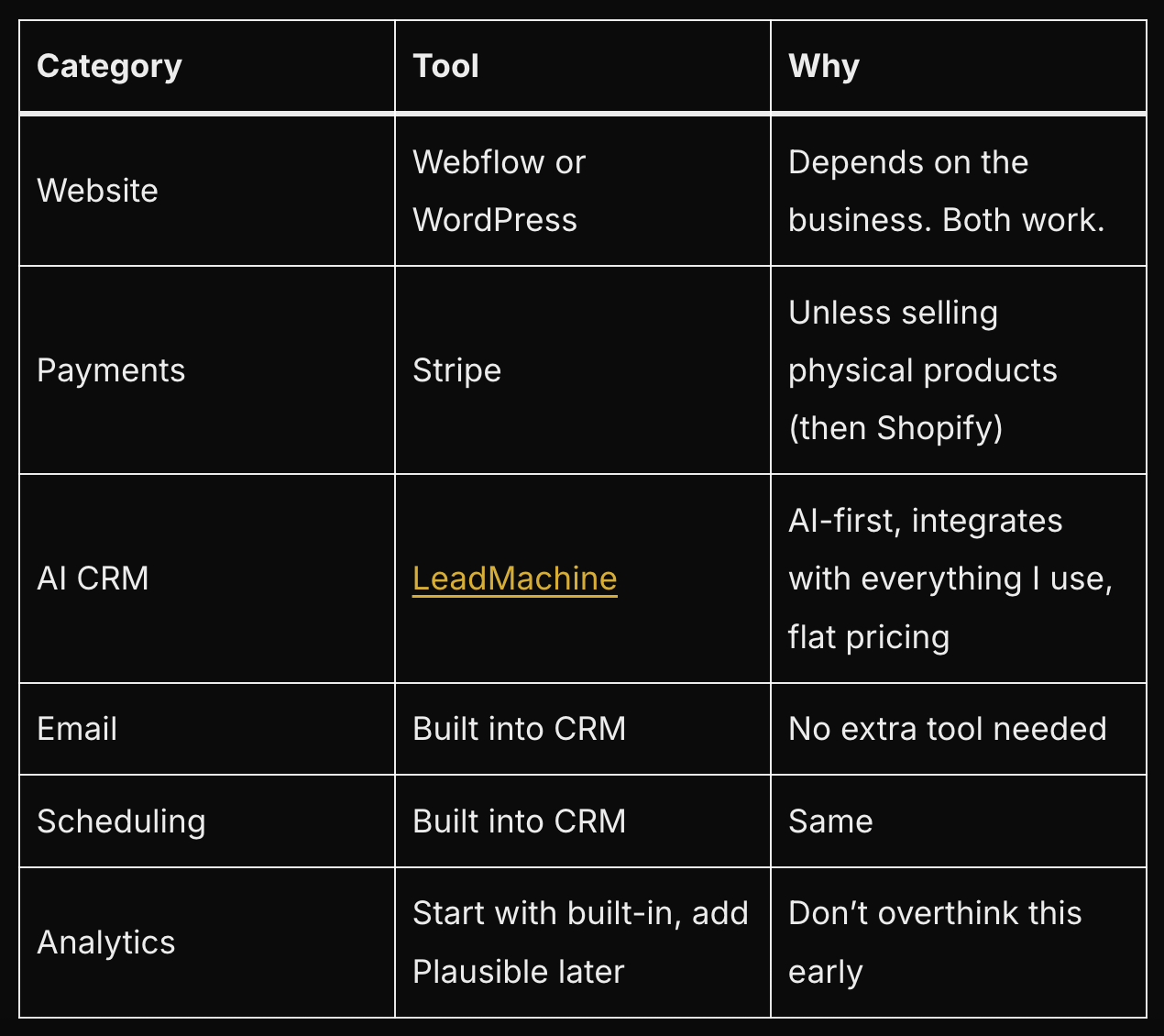
Total monthly cost: Under $200 for everything a small team needs.
Compare that to the enterprise stack (Salesforce + Marketo + Calendly + a bunch of Zapier connections) and you’re looking at 10x the cost and 20x the complexity.
For the 33%
If you’re one of the one-in-three thinking about starting something this year, here’s my honest advice:
Don’t let tool selection become an excuse not to start.
Pick a stack that works together. Set it up once. Then forget about it and go talk to customers.
The founders who win in 2026 won’t be the ones with the most sophisticated tech stack. They’ll be the ones who picked good-enough tools quickly, stayed focused on the work that matters, and built real relationships with real customers.
The tech has never been more accessible. The AI has never been more useful. The timing has never been better.
You’ve got this.
Jay Thornton is co-founder of LeadMachine, an AI CRM built for small sales teams. He writes about building software, starting businesses, and the tools that actually help.