Trust is the best marketing strategy ~via jobs.bg
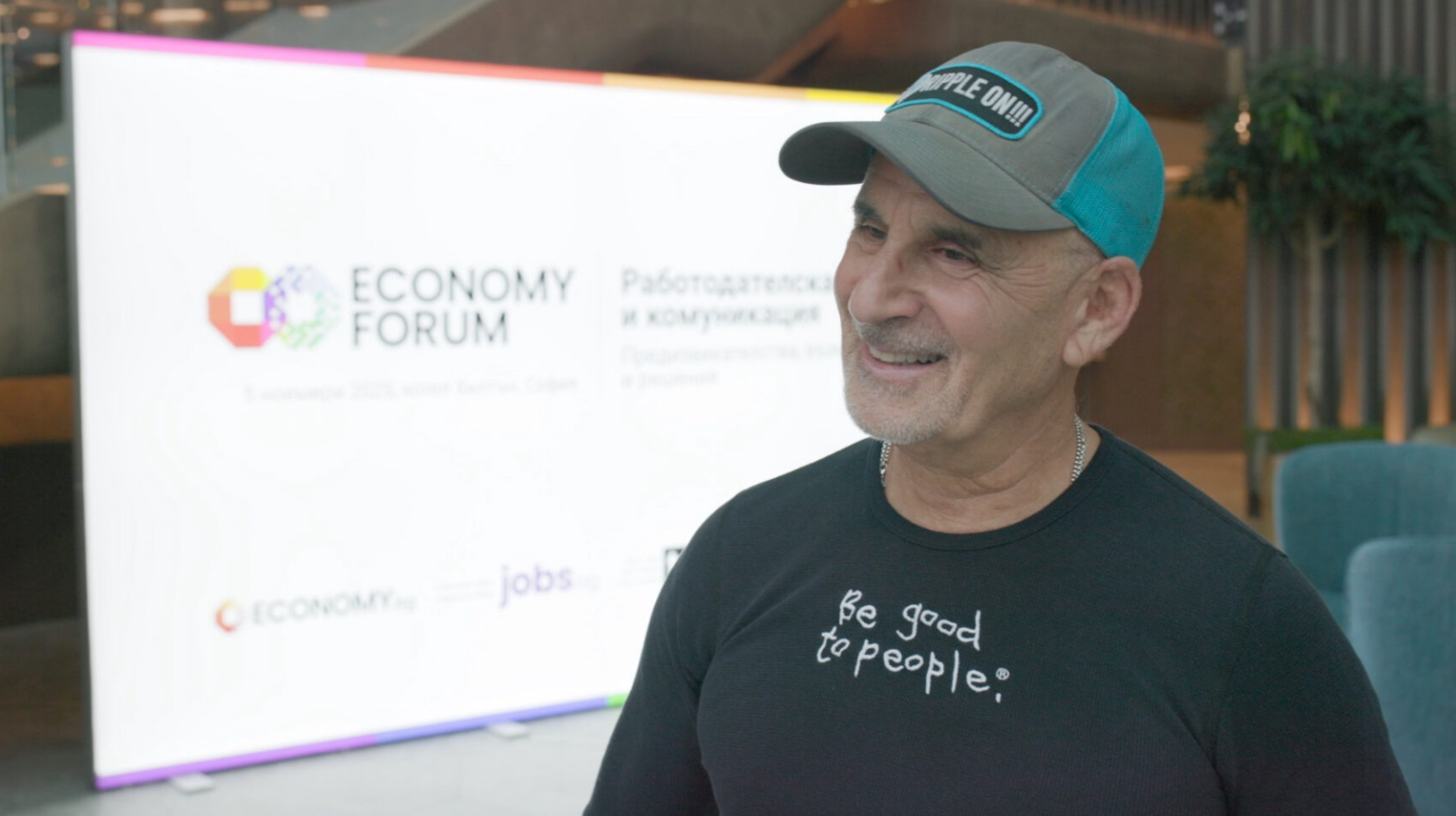
I had the good fortune to deliver the closing keynote at ECONOMY.bg’s EconomyForum. Sharing that a crucial element of ‘Employer Branding’ is to… Empower your Employees, and THEY will Power your Brand! AND that leads to powerful RETURN ON RELATIONSHIP! Afterward, I talked about TRUST with jobs.bg. /Ted
Hear about the concept of Return on Relationship and why companies should focus not on the numbers but on the relationships that bring loyalty from Ted Rubin — a top expert in social marketing, who participated in EconomyForum, organized by Jobs.bg and Economy.bg
Ted Rubin – a leading social marketing strategist, author and globally recognized speaker – believes that true value in business comes not from the number of followers, but from the power of human connections. He believes that trust and authentic relationships are the most valuable currency in the business world and that every brand must connect with people first before trying to sell them something.
How his philosophy of „returns from relationships“ was born, why relationships are more valuable than numbers, how social networks can build trust, not just followers – these and other questions we discussed with Ted Rubin. He shared his experience and best practices at EconomyForum – Employer Branding and Communication, organized by Jobs.bg and Economy.bg. More about the event here
Ted Rubin is a leading social marketing strategist, speaker, author, strategic marketing consultant, and people connect. In March 2009, he began using and popularizing the term ROR – Return on Relationship, a concept that he believes is the foundation for building an engaged community among employees and naturally turning them into active advocates for the company’s brand.
Ted is ranked #13 on the Forbes Top 50 Social Media Power Influencers and #2 on the Leadtail Top 25 People Most Mentioned by Digital Marketers, and was recently named to the leadersHum Global Power List of the Top 200 Biggest Voices in Leadership. The Return on Relationship, ROR, #RonR concept is at the heart of his philosophy – it’s all about relationships.
Ted is the author of several books: Return on Relationship (2013), How to Look People in the Eye Digitally (2015), The Age of Influence (2017), and Retail Relevancy (2022, with an upcoming updated edition).
Ted, how did you get into relationship marketing? Is it based on personal experience?
I don’t really think of it as “marketing.” I think more about building relationships between people. Yes, I have personal experience that led me to this. It comes mainly from my family, especially my father. He was the kind of guy who would stop on the street to pick up a fallen trash can. He would help strangers, even in neighborhoods where we didn’t know anyone. I would sit in the car and watch him. Eventually, I started doing the same thing—he taught me.
I remember when I started my first job. Part of it was setting up sales meetings. At the end of the week, my dad asked me, „How’s it going? Do you have a meeting?“ I said, „Yeah, next Thursday at 10:00.“ He said, „When are you going?“ I said, „Maybe five minutes before.“ He said, „No. Go an hour early.“ This was in the 1980s – there was no social media, no internet. He said, „Walk around the neighborhood. See what restaurants they have. Go into the building, see what other companies are there. Go to the office early and see if the assistant of the person you’re meeting with will let you in. Look at what’s on the desk, on the walls – pictures, diplomas – look for an emotional connection.“ He taught me that the best way to make a sale or convince someone is to connect with them through something that’s important to them, not through what you want to sell them. Don’t go in to sell. Go in to connect. If the person has grandchildren, talk about them. If they like fishing or golf, start there. That’s how you create a conversation, not a sale.
That’s how it all started. Later, I had a mentor in business who gave me the same advice. I remember telling him, “You’re not telling me anything about products, you’re not giving me specific sales techniques,” and he said, “I’m teaching you something more valuable than any closing technique—the ability to build relationships. They’ll help you throughout your life.”
You say relationships are more important than numbers in business. Why?
Because relationships are like muscles. The more you use them, the stronger and more valuable they become. The more you talk to someone, the more you get to know and share with them. Think of someone you’ve known since you were a kid and had the time to get to know them. You played together, you hung out, you knew their family. You may not have seen each other for 40 years and when you meet again, you start to remember, to share, and you feel that your connection is still there. Relationships between people are much more than numbers. That’s why I say: Return on Relationship increases Return on Investment. Why? Because if you take 2 identical products or advertisements, the ones that are built around real human relationships will always have a much greater effect.
Can you give an example of a company that manages to truly connect with people online?
Unfortunately, there are fewer and fewer of them. The reason is the advent of AI and automation. Delta Airlines used to be a great example. They had a special social media team that didn’t deal with advertising, but responded to people – to tweets, to Facebook posts, to questions. They made people feel important. I was a big fan of theirs because I had a lot of miles and received privileges. They were also reliable. As a loyal customer, I often shared photos from my flights with their hashtag, and they always responded. Now they don’t. If my flight was delayed before, I could write to them and they would help me immediately. Now there is no such reaction. Today, small businesses tend to do better – when the communication comes directly from the owner or leader, who sets a personal example.
How can small companies with limited resources build a good brand online?
If I were starting a small business today, or if I had to give advice to a small company, I would tell them to give their employees more freedom. “Make sure everyone has an Instagram account. Make sure everyone is posting. Tell them that you want them to share not just about your products or a sale, but about what they’re doing in the office today, what project they’re working on, things that make people feel engaged and connected.” Because when you have a small business, you can manage that very easily. You don’t have to worry about a bunch of employees who might be doing something you don’t know about. If you have 10 employees, you can gather them around the table every morning and say, “Here’s the plan for today. I want you to do 5 posts related to what we do.”
What makes people trust brands online?
Honesty. There’s a lot of talk about “authenticity,” but it’s often misinterpreted. Companies need to own up to their mistakes. When someone criticizes them, they shouldn’t hide. Even negative comments have value. If you’re wrong, say so. When people complain, it’s an opportunity. Because behind one person who complains, there are usually 20 more who are silent or simply stop buying. If you engage with that person and understand what their problem is, then you can be honest. For example: “This is not something we can fix because the product costs us more now because of customs or other circumstances, so we have to increase the price. I’m very sorry and thank you for sharing.” Then you can think of ways to make the product more affordable.