AI: Advertising's New Channel ~via Robbie Caploe
Robbie is focused on the next major shift in media: the commercialization of Large Language Models (LLMs). As the infrastructure for advertising inside generative AI is built in real-time, she is helping brands and platforms move beyond "old ad logic" to build the mental models required for this new medium. -Ted
Over the past year, something subtle but consequential has begun to happen: Large Language Models have moved from being a technology curiosity to a commercial priority for platforms, vendors, and regulators alike.
Not because anyone suddenly discovered AI (that story is already tired) but because platforms, vendors, and regulators are building the infrastructure that will determine how advertising works inside LLMs—before most advertisers are paying attention.
That shift matters.
If the first shift was behavioral (people going to AI to ask, compare, and decide) this next shift is commercial.
Advertising inside an LLM is not the same thing as advertising around AI usage, or optimizing for visibility in AI-driven discovery. It is a fundamentally different media problem: one that doesn’t behave like search, display, or social, no matter how tempting it is to borrow the language.
Why old ad logic breaks here
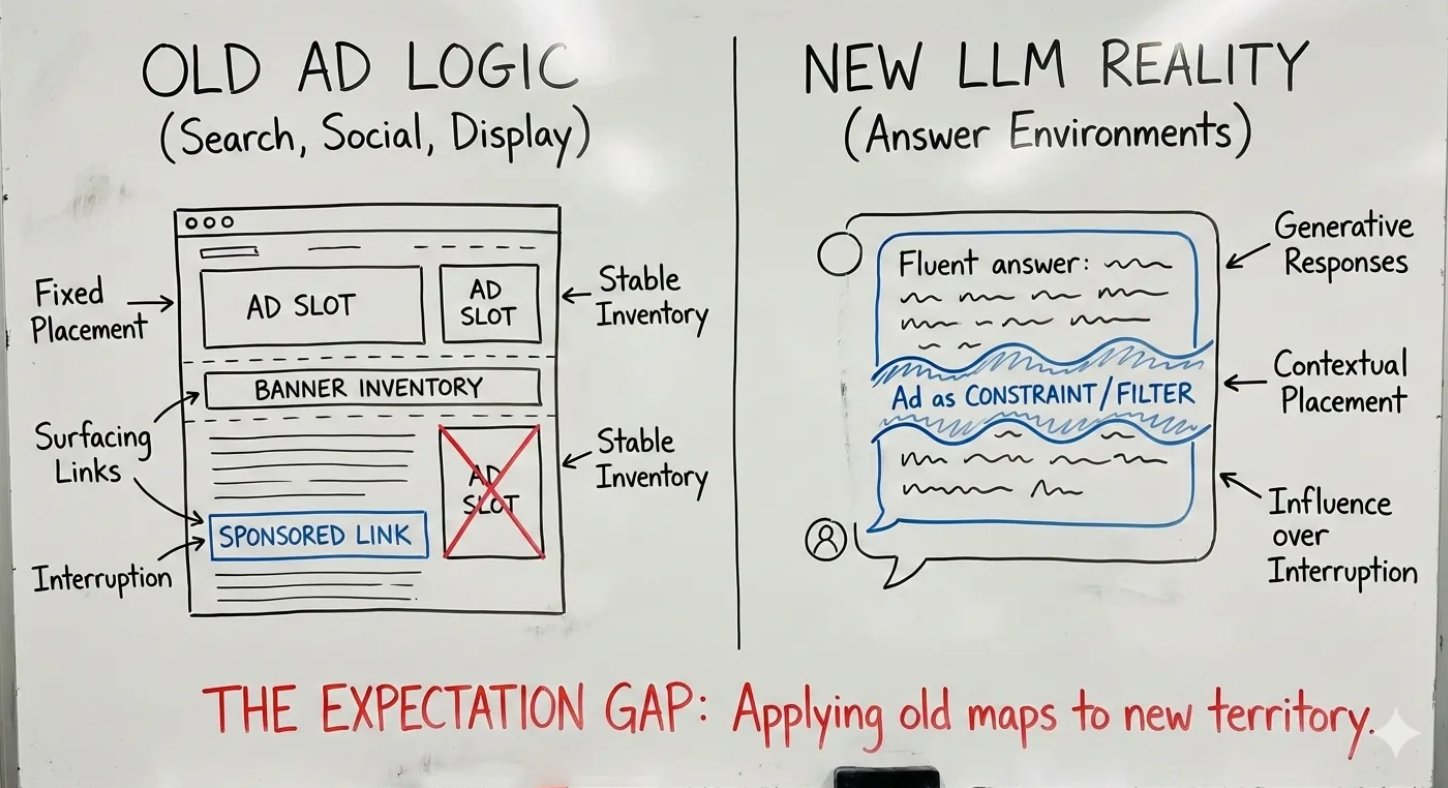
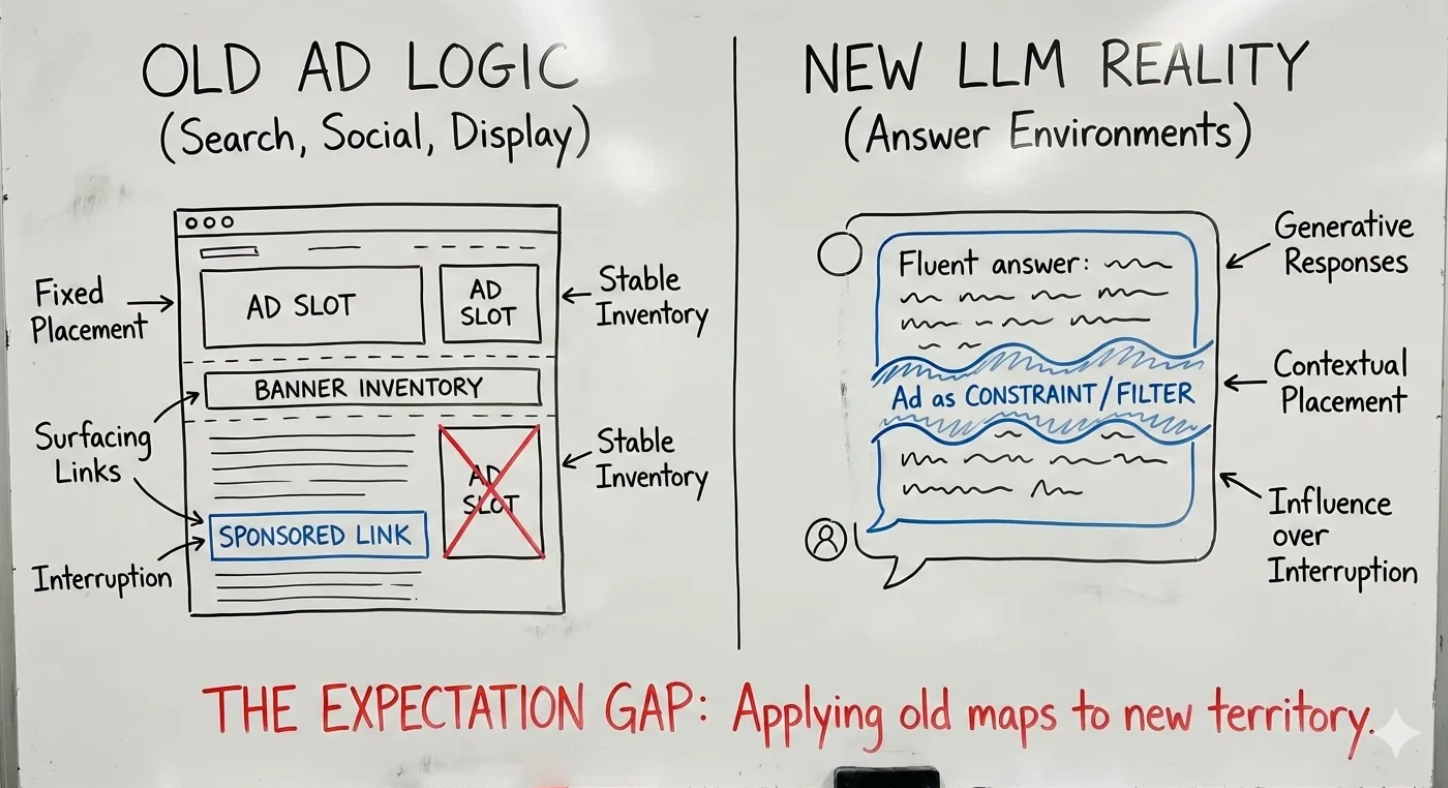
LLMs are answer environments. Their core function is to generate responses that feel complete and useful, not to surface links or inventory.
Advertising enters this system as a constraint layered onto an answer, not as a slot waiting to be filled.
That difference has consequences.
There is no stable inventory in the traditional sense.
Placement is contextual rather than fixed.
Creative is interpreted by the system before it is ever surfaced.
And control looks different when the interface itself is generative.
If this feels uncomfortable, it’s because most advertising systems we know were designed for ads. LLMs weren’t. Advertising is being added after the fact, which means familiar assumptions don’t map cleanly.
A signal worth noticing: regulation is being written in real time
One of the clearest indicators that LLMs are becoming an advertising channel and not just a technology is that advertising standards bodies are already moving into the space.
In the U.S., the Federal Trade Commission has focused on AI disclosure requirements and deceptive practices, signaling how regulators are likely to approach advertising in AI systems, while industry bodies like the IAB Tech Lab are working through how accountability and measurement might function when ads appear inside generative systems.
That doesn’t typically happen for experiments. It happens when a medium is expected to carry commercial influence at scale.
Regulation usually lags media innovation. The fact that these conversations are starting now, before formats are fully defined and before buying systems are standardized, is worth paying attention to.
What’s actually at stake for advertisers
The real risk here isn’t missing a first-mover advantage. It’s misapplying familiar playbooks to a system that rewards different behavior.
Inside LLMs:
advertising has to coexist with the model’s obligation to be helpful
measurement is likely to be indirect and probabilistic before it is precise
success may look more like influence than interruption
vendor promises will often outpace platform reality
None of this means advertising in LLMs won’t work. It means it won’t work the way we expect; and that expectation gap is where most early mistakes will happen.
How to think about this moment
Right now, the work isn’t tactical execution. It’s orientation.
That orientation shows up in behavior.
It looks like noticing where you’re instinctively borrowing language from search, social, or programmatic (i.e., inventory, placement, optimization, clicks) and asking whether those concepts actually apply inside an answer-based system.
It looks like slowing budget conversations down until there is clarity about what is actually being bought, where advertising surfaces inside an answer, and what “success” means before measurement frameworks are fully formed.
And it looks like changing the questions you ask vendors away from guarantees, and toward mechanics:
How does the model decide when and how an ad appears?
What control do advertisers actually have — and what do they not?
What can be measured now, and what is still inferred?
Those answers will tell you far more than a case study ever could.
That’s what this Substack is for: helping you build the mental model first, so when the tactics arrive (and they will), you’re ready to evaluate them with clear eyes.
This is the first of a few shared reference points I’ll keep building as advertising inside LLMs takes shape. Because it helps to have a common vocabulary, I’ve put together a working glossary of terms around LLM advertising for you to to use alongside this piece and beyond.