The Industry Just Discovered Practical AI. Here Is What We Learned Building It. ~via Jay Thornton
Tech analysts are calling 2026 the year AI gets useful. Jay Thornton and Michael Fraser have been asking that question since they wrote their first line of code for LeadMachine. /Ted
Tech analysts are calling 2026 the year AI gets useful. We have been asking that question since we wrote our first line of code.
The term “pragmatic AI” is everywhere right now. TechCrunch dedicated a piece to it. MIT Sloan Management Review published a study on it. Analysts who spent three years hyping AI agents are now writing about something they are calling “the harder work of making AI usable.”
The consensus has landed: 2026 is the year AI is supposed to stop showing off and start working.
I read all of this with a particular feeling. Not satisfaction, exactly. More like recognition. Because Mike Fraser and I have been sitting with that question since we started building LeadMachine. Not because we predicted the trend. Because the people we built this for have never had patience for anything else.
The Question That Shaped Everything
Here is the question we started with.
What does AI look like when it actually fits into a small business owner’s day?
Not the demo version. Not the investor deck version. The version where a sales rep with seven open deals and three callbacks still to make has to decide whether to open yet another tool.
We talked to a lot of small business owners and solo operators before we wrote the first line of code. The things they told us were consistent.
They were not looking for more features. They were looking for fewer decisions. They did not want a dashboard with fourteen charts. They wanted to know what to do next. They did not distrust AI because it was too powerful. They distrusted it because every time they used it, they had to manage the AI as much as the task.
That is what practical AI means on the ground. Not a capability benchmark. An experience benchmark. Does this thing make my day easier, or does it make my day longer?
What We Built Instead of a Dashboard
When we designed the interaction model for Ledo, the AI assistant inside LeadMachine, we kept pulling in the same direction. Less.
Not fewer features. Fewer interruptions. Fewer configuration screens. Fewer moments where the user has to think about the tool instead of the work.
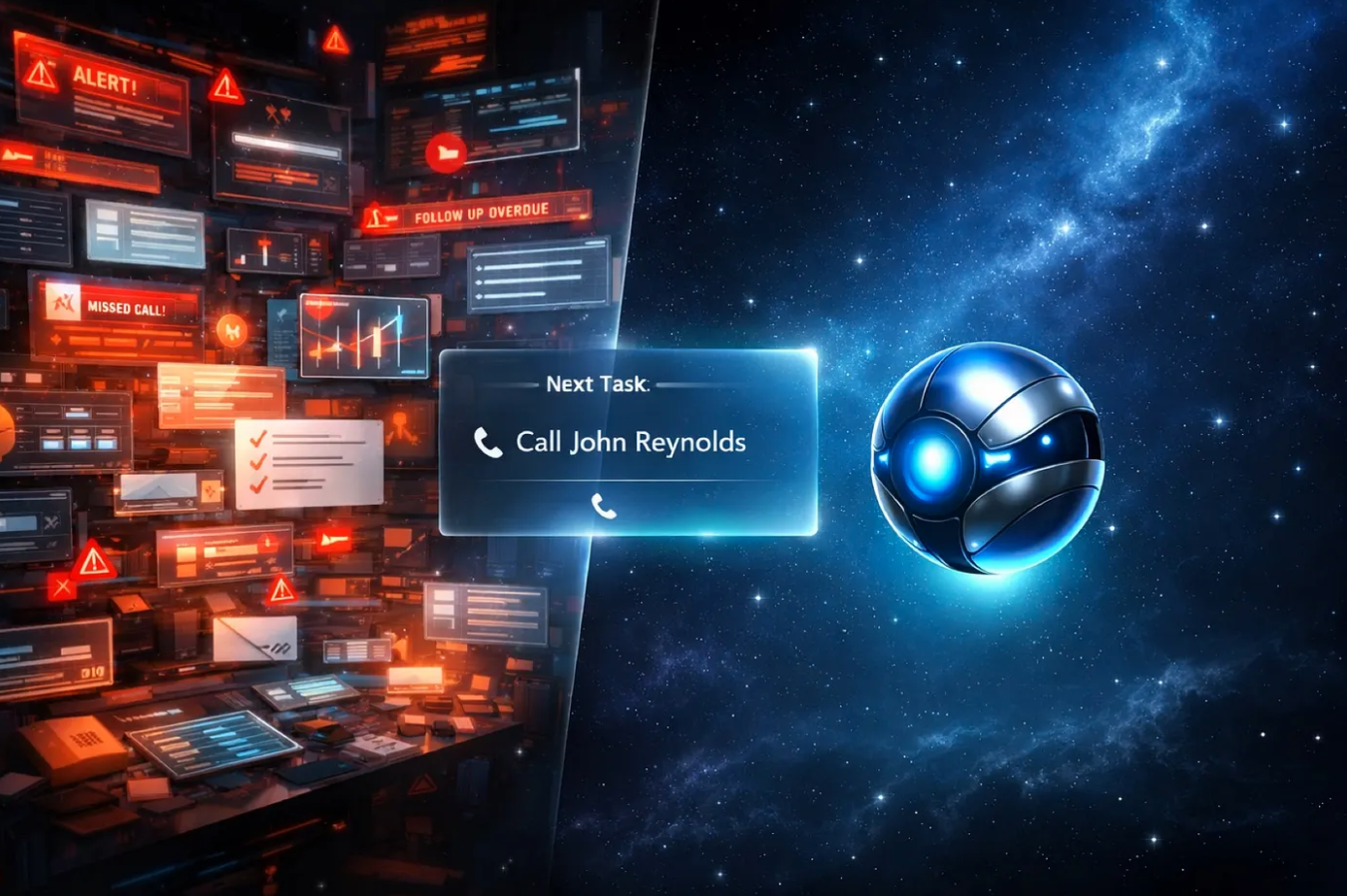
Focus Mode is probably the clearest example of this. Instead of showing you everything happening in your pipeline at once, Ledo surfaces the single most important action in front of you right now. One thing. The one that will move the most weight today. You deal with it and move on.
That sounds simple. It is not. To produce that one recommendation, Ledo is doing a lot of work underneath. It is looking at deal age, response patterns, communication history, pipeline stage, and the broader shape of your funnel. It surfaces the signal. It hides the math.
The same logic runs through everything we built. Daily briefings give you the state of your pipeline in two or three sentences instead of a scrolling overview. Meeting prep happens automatically before a scheduled call. Follow-up sequences run in the background without reminder emails to yourself.
We started calling this the Calm Operator approach. AI that shows up when it is useful and stays quiet when it is not. The goal is for every interaction with Ledo to leave you more clear-headed, not more overwhelmed.
The Noise Problem No One Talks About
There is a version of “AI is getting practical” that is still missing the point.
Most AI tools are getting better at specific tasks. They summarize faster. They write more fluently. They generate outputs that require fewer corrections. Those are real improvements and they matter.
The noise problem is this: small business owners already have too many tools competing for their attention. They have project management notifications, CRM reminders, email threads, Slack channels, and calendar invites. Adding better AI to that stack does not reduce the noise. It adds a new source of it.
We designed LeadMachine around a different assumption. The value of AI in a CRM is not the quality of any single output. It is the accumulation of context over time, applied quietly at the moment you need it.
When Ledo researches a new lead, it is not running a one-off lookup. It is building a record: company data, social profiles, estimated business size, relevant news, and open follow-up history from every previous interaction in your pipeline. When you go into a meeting, Ledo already knows what you need to know. You did not ask for it. It was there.
That is a different relationship with AI than prompting a chatbot before a call. It is more like working with someone who has already read your notes.
What Practical AI Actually Costs
There is one more dimension to this that I want to say plainly, because I think it matters and does not get talked about enough in the “AI goes practical” narrative. Practical AI has to be affordable.
This might sound like a pricing argument, and it is, but it is also something more fundamental. If AI is genuinely becoming the operating layer of business, and I believe it is, then the businesses that cannot afford it are going to fall behind. Permanently. Not because they made bad decisions. Because the tools were priced for someone else.
We set LeadMachine at $58 per month specifically to prevent that from happening to the people we built this for.
No per-seat pricing that grows painful the moment you hire someone. No premium tier where the AI features that actually matter cost extra. No AI usage cap that punishes you for using the thing you paid for.
Everything Ledo can do, every enrichment, every briefing, every pipeline suggestion, every Follow Mode recommendation, is included at that price. For the solo consultant and the five-person sales team and the Shopify merchant managing two hundred customer relationships without a dedicated CRM admin.
The industry is figuring out that practical AI is the goal. We agree. We just think practical also means within reach.
What We Are Still Learning
I do not want to make this sound like we solved it.
The Calm Operator approach is a philosophy, and like any philosophy, it is something you are always moving toward rather than arriving at. Ledo is getting better at knowing when to surface information and when to let it rest. Our briefings are getting more specific. The pipeline suggestions are improving as we see more patterns across more businesses.
There are still moments where Ledo says something obvious or misses something it should have caught. We are paying attention to every one of them.
What I do feel confident about is the direction. The question we started with, what does AI look like when it actually fits into a small business owner’s day, is the right question. And the work of answering it is not finished. But it has never been more relevant.
If you are running a small business and you want to see what a practical AI CRM looks like in the current version of LeadMachine, you can start a 14-day free trial at leadmachine.fyi. No credit card. No configuration consultant. Ledo starts working the moment you add a lead.
More soon. — Jay