What Makes a City Well-Managed? ~via John Andrews
Thanks to John , who so often expands my thinking… his post is not only valuable, but equally important, it’s engaging, easy to read, and something that pulled me in, made me want to keep reading, and absorb it all.
THAT is also what so many people miss when using AI to create content. If what you write doesn’t draw people in and make them want to stay with it… did the tree actually fall in the woods? /Ted
An Old Answer We Forgot
In 1895, when Andrew Carnegie funded the public library system in Pittsburgh, he made a decision that most librarians of the era considered reckless. He insisted on open shelves. Patrons would be allowed to walk into the library, browse the collection themselves, and choose what they wanted to read. This was unusual. Most libraries of the period operated as closed collections, with patrons handing requests to staff who retrieved books from locked stacks. The reasoning was straightforward and condescending: books were valuable, citizens were not entirely trustworthy, and direct access invited theft and damage.
Carnegie didn’t agree. He believed libraries should treat citizens as capable adults who could manage themselves. The institution would extend trust; the citizens would reward it by participating. He turned out to be right. Pittsburgh’s library system became one of the most heavily used per capita in the country, a position it still holds today.
This is a small story about a decision made 130 years ago. It is also the most important variable in whether a city works.
Somewhere in the last fifty years, we started thinking of ourselves as customers of our cities rather than citizens of them. The rankings reflect this. So does the political dysfunction that followed. The argument of this piece is that we got the question wrong, and the right answer was discovered almost two hundred years ago by a French aristocrat who came to America to study prisons.
The right answer is reciprocity. A well-managed city is one where citizens and government are both holding up their end of an old contract. We have forgotten this, and our rankings reflect the forgetting.
How This Inquiry Started
A friend asked a simple question on Facebook this week. What are the top three best-managed cities in the United States? Mark Fidelman put it out to his network the way people put out questions on Facebook — open-ended, no criteria, fishing for opinions. The question stayed with me because the answer most people give is wrong in interesting ways, and the right answer requires a different kind of thinking than what rankings are built to support.
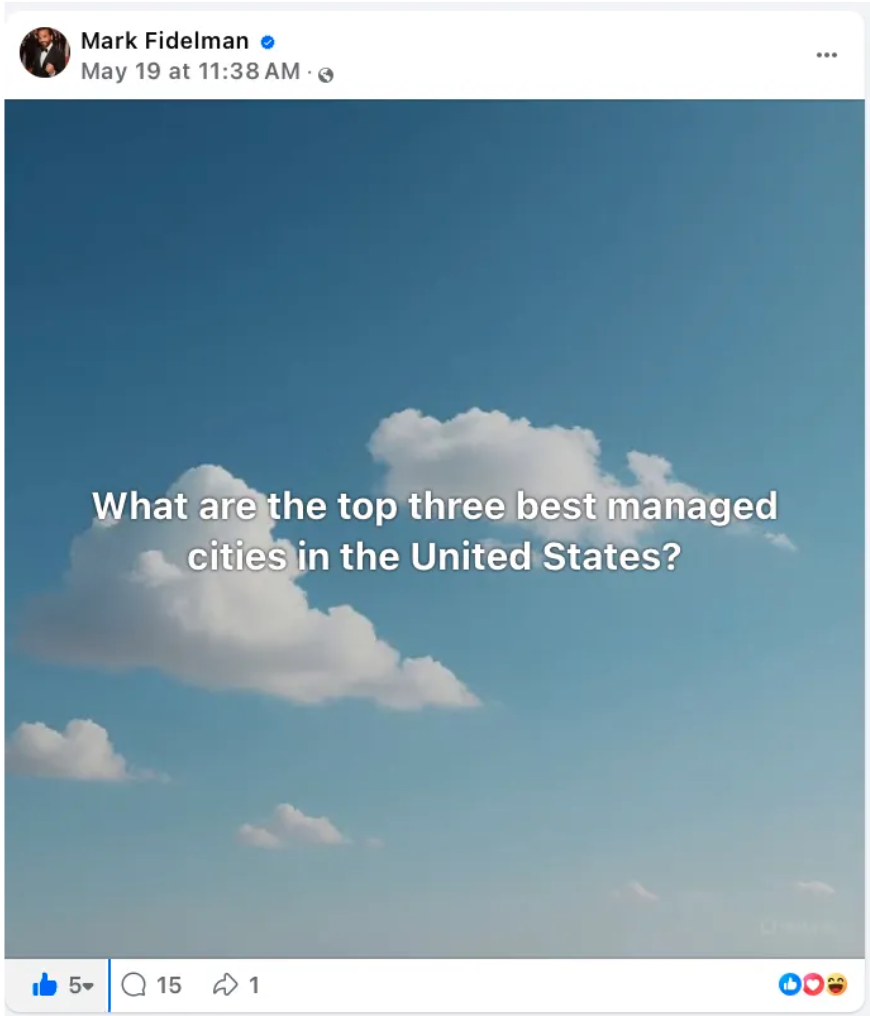
Mark’s original post. The kind of question that looks simple until you start trying to answer it.
I teach at Lenoir-Rhyne University in Hickory, North Carolina, where I also graduated in 1995. My family moved back when our daughter headed off to college. We loved Raleigh, but a new phase of life gave us the chance to consider something different, and Hickory was a strong option largely because of how it’s been managed. City Walk is a real piece of civic infrastructure. The universities are integrated into the city in ways that matter. The civic and religious engagement is genuine. None of this happened by accident. Someone made decisions, over the years, that produced a city worth choosing in middle age. That kind of management is what this piece is trying to name.
What Tocqueville Saw That Nobody Else Did
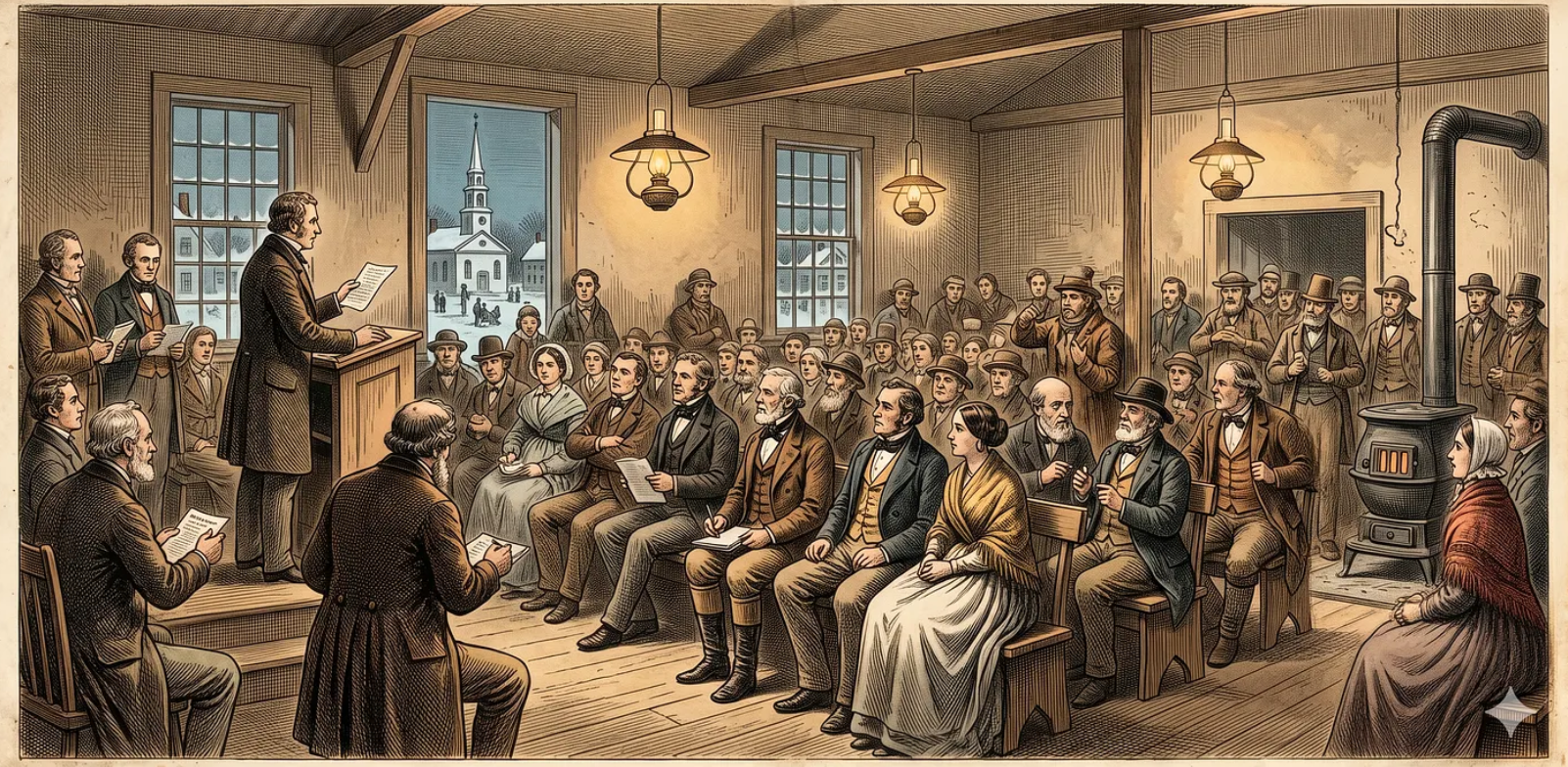
A New England town meeting in the 1830s, the kind of gathering Tocqueville described as a “small school of democracy.” The habit of association was the structure, not the ornamentation. Image Source: Gemini
Alexis de Tocqueville arrived in America in 1831. He was twenty-five years old, a minor French nobleman officially sent to study the American prison system, unofficially sent to figure out how this strange democracy worked. He spent nine months traveling from New England to the Mississippi Delta, in conditions that would make modern travelers weep. He nearly drowned crossing the frozen Ohio River when his steamboat hit ice. He met Andrew Jackson and was unimpressed, describing the president as a man of “violent character and middling capacities.” He took notes constantly. When he went home, he wrote Democracy in America, which is still the most penetrating book ever written about what makes American civic life work or fail.
What Tocqueville saw in America that he didn’t see in Europe was the habit of association. Citizens joined things. They formed associations for every conceivable purpose. He wrote, in the passage that has been quoted so many times, it sounds like a cliché but isn’t: “Americans of all ages, all stations of life, and all types of disposition are forever forming associations. There are not only commercial and industrial associations in which all take part, but others of a thousand different types — religious, moral, serious, futile, very general and very limited, immensely large and very minute.”
This wasn’t ornamentation on American life. It was the structure. Citizens built churches, schools, libraries, fire brigades, mutual aid societies, temperance societies, abolitionist societies, and agricultural improvement societies. They served on town councils. They attended meetings. They picked up the trash, literally and metaphorically. And they did this not because the government compelled them but because they understood that the place was theirs and would be what they made of it.
Tocqueville saw that this habit was producing something specific. It was producing citizens capable of self-government. Each association was a small school of democracy. You learned how to disagree without violence. How to compromise. How to lose a vote and accept the outcome. How to take responsibility for things larger than yourself. These lessons couldn’t be taught abstractly. They had to be lived.
He also saw, with the clarity that often comes from being a foreigner, that this was fragile. He warned about what would happen if it eroded. A society where citizens stopped joining things and started waiting for government to handle them would not just have weaker civil society. It would have weaker government too, because the two were producing each other. The strong civic culture made the government work. The responsive government gave citizens reason to participate. Take away either side and the engine stops.
He called the worst version of this “soft despotism.” A condition where citizens become so accustomed to having government provide for them that they lose the capacity to provide for themselves and each other. The government in this scenario doesn’t have to be tyrannical. It just has to be the only thing acting. Citizens become spectators in their own civic lives. They wait. They complain. They consume. They no longer build.
“A nation of consumers cannot remain a self-governing nation, no matter how nominally democratic its institutions remain.”
Tocqueville wrote this in 1840. He was describing a future he hoped America would avoid. We did not avoid it everywhere, and the cities that did are the cities that are well-managed today.
The Variable Hiding In Plain Sight
Most rankings of well-managed cities miss this entirely. WalletHub measures service efficiency. Truth in Accounting measures fiscal discipline. Mercer measures quality of life for expatriate executives. Each captures something real. None captures the relationship between citizens and government, which is the variable that actually predicts whether a city works.
The rankings yield strange results because they measure only one side of a contract. WalletHub names Provo, Boise, and Nampa as the best-run cities in America. These are small, affluent, demographically homogeneous places where the contract is largely transactional. Services rendered, taxes paid, no need for much civic life beyond what individuals construct in their families and churches. There is nothing wrong with this exactly. It just isn’t what Tocqueville was describing, and it isn’t what makes a city vibrant.
If your ranking of the best-managed cities in America puts at the top a city most Americans have never heard of, you don’t have a discovery on your hands. You have a methodology problem. A fair number of readers just had to look up where Nampa is. Nampa is in Idaho. Its appearance at the top of a national ranking is not evidence of hidden excellence. It is evidence that the ranking is measuring the wrong thing.
Truth in Accounting names Washington D.C., Irvine, and Charlotte for fiscal health. Irvine sits on master-planned land entitlements that generate revenue most cities will never see. Washington, D.C., controls its own income tax and has a commercial property base that no other US city can match. Charlotte benefits from being a banking capital. Fiscal management is real in each case, but the starting conditions did most of the work. The conventional rankings reward inherited conditions and call it leadership. They measure inputs and call them outcomes. They confuse starting position with running speed.
What they miss is whether citizens are showing up and whether the government is responding. The reciprocity variable. The contract runs in both directions. A city where the government delivers everything but citizens free-ride becomes brittle, because the government has no real legitimacy and no real partners. A city where citizens are civic but the government fails becomes exhausted because residents carry the weight that institutions should bear. The vibrant city is the one where both sides show up.
The Framework That Got Us Here
The conventional rankings are one problem. The other is the framework that dominated municipal thinking for the last two decades. Richard Florida’s Rise of the Creative Class, published in 2002, gave mayors and economic development offices a playbook: attract talented professionals — what Florida called the creative class — and the prosperity follows. Cities responded by competing on amenities. Bike lanes, coffee shops, walkable downtowns, public art, the visible markers of cool. The strategy worked, in a narrow sense. Cities that successfully attracted creative class workers saw measurable economic gains.
But the strategy also produced what we’re living with now. Housing affordability crises in every city, Florida’s framework praised. Civic life thinned to consumption of urban amenities rather than participation in urban life. Neighborhoods optimized for the preferences of mobile professionals rather than the lives of long-term residents. A municipal policy environment that treated citizens as customers to be attracted rather than partners to be cultivated. Florida himself has spent the last decade walking back parts of his framework, acknowledging in The New Urban Crisis that the creative class strategy worsened inequality and undermined the broader civic fabric. The acknowledgment is welcome but late. Two decades of municipal optimization for the creative class have produced cities that are great to visit and increasingly impossible to inhabit.
The reciprocity framework points in the opposite direction. Stop optimizing for who you can attract. Start measuring whether the people already there are showing up for each other.
The Data Tells A Different Story
Once you start looking for reciprocity, the data is everywhere.
Volunteering rates by metro area come from the Corporation for National and Community Service. They range from about 17% in some Southern metros to 45% in Minneapolis-Saint Paul and Salt Lake City. Municipal election turnout, tracked by Portland State University’s Who Votes for Mayor project, ranges from under 15% in cities like Las Vegas and Fort Worth to over 50% in Minneapolis and Portland, Maine. Charitable giving as a percentage of income, from IRS data, shows that Salt Lake City, Memphis, and Birmingham give higher percentages than San Francisco or Boston. The Chetty team’s Social Capital Atlas, released by Opportunity Insights, measures economic connectedness across class lines at the zip code level — a genuinely new dataset that almost nobody is using.
On the government side, 311 response times indicate whether cities are responding to residents' reports. Permit processing times indicate whether cities honor citizens who follow the rules. Local journalism survival, tracked by UNC’s Hussman School, indicates whether the information infrastructure that enables accountability still exists.
Run these together and the rankings reorder dramatically.
Minneapolis-Saint Paul ranks near the top in nearly every reciprocity measure. Volunteering rates among the highest in the country. Municipal election turnout consistently above 40%, sometimes over 60%. Functional 311 systems. The Star Tribune is still operating as a real metro daily, increasingly rare. Strong return migration. Even the 2020 crisis was a story of reciprocity. The breakdown exposed the contract, and the work of rebuilding it is itself the management story.
Madison, Burlington, and Iowa City punch far above their weight. Small cities where citizens actually attend things, the government actually responds, and the relationship between the two is visible on any given Tuesday. The reciprocity infrastructure is dense enough that residents and officials know each other by name, which changes what kind of government is possible.
Salt Lake City surprises people who don’t know the data. Charitable giving among the highest in the country. Volunteering rates exceptional. Civic association density is real, much of it religious, which is part of the Tocquevillean point. Voluntary associations, whether religious or secular, do the same civic work. He explicitly named religious associations as central to the American pattern he was describing. Pretending this doesn’t matter to be modern produces worse analysis.
Pittsburgh is the visible reciprocity case. People stayed when they didn’t have to. The city lost more than half its population from its peak, but the people who remained built something. Neighborhood associations are among the densest in any American city. The Carnegie Library system is genuinely vital — Andrew Carnegie’s instinct about open shelves turned out to be right not just for libraries but as a theory of how institutions and citizens should treat each other. The fiscal recovery story is real, but downstream of something deeper. A population decided the city was worth rebuilding and acted accordingly, while the government slowly caught up.
The cities that conventional rankings love but the reciprocity framework rejects include Provo, Irvine, Plano, Phoenix, Las Vegas, Houston, and most of the Sun Belt. They share something. Low municipal election turnout. Weak civic association density. Transactional relationships between residents and government. Services rendered, contract fulfilled, no civic life beyond what individuals construct for themselves. Tocqueville would have recognized this immediately. It is the soft despotism he warned about, arriving not through tyranny but through convenience.
A Moment Of Honest Doubt
Before going further, I should admit something. The reciprocity framework, as I’ve described it, favors a certain kind of city — older, denser, colder, more communitarian. The data doesn’t lie, but the framework is also doing some work to produce the answer I wanted. A different lens would find different winners. A pure capability framework focused on intergenerational economic mobility would put different cities at the top. A framework that weighted economic dynamism heavily would surface Austin, Nashville, Raleigh-Durham, places where the contract is thinner but opportunity is real. A framework built around climate resilience would yet name a third set.
The honest version of this piece has to name that. The reciprocity framework is defensible, but defensibility isn’t the same as objectivity. It’s a values choice dressed in data. I think it’s the right values choice. I also think you should know it’s a choice.
What I’m more confident about is that the conventional rankings are wrong in ways that aren’t defensible. Optimizing for fiscal cleanliness while ignoring whether anyone shows up to vote is not measuring city management. It is measuring municipal accounting. These are different things, and the rankings industry has been pretending otherwise for too long.
Three Things That Surprised Me
Three patterns surfaced from the reciprocity data that nobody predicted at the start.
Religious infrastructure matters more than secular discourse credits. Salt Lake City, Charleston, and parts of the South exhibit strong reciprocity, in part because the religious community provides voluntary association infrastructure. Tocqueville saw this explicitly. He wrote that “religion in America takes no direct part in the government of society, but it must be regarded as the first of their political institutions.” He didn’t mean religion shaped policy. He meant religion built the habits of association that made democracy possible. Pretending this doesn’t matter to be polite produces worse analysis. The cities that have a strong religious community alongside other civic infrastructure outperform the cities that have neither.
Small and mid-sized cities dominate the top of the reciprocity list. Madison, Burlington, Iowa City, Portland Maine, parts of Pittsburgh’s neighborhood structure. Reciprocity may scale poorly. Beyond a certain size, the relationship between residents and government becomes too abstract to support the contract. You can’t know your council member if there are eight hundred thousand of you. You can’t run into the mayor at the coffee shop if the city has fifteen layers of bureaucracy between you and her. This complicates the assumption that great cities are big cities. Some of the most well-managed American cities by reciprocity measures are places nobody talks about because they’re not impressive enough.
Cold-climate cities outperform warm-climate ones. Minneapolis, Madison, Burlington, Iowa City, Portland, Maine. When you need your neighbors to survive winter, you build different relationships than when you don’t. The shared experience of difficulty produces a kind of solidarity that easier climates don’t require. This is speculative, but the pattern is real and worth sitting with. Tocqueville visited New England in winter and noted the density of mutual aid. He visited the slaveholding South and noted its absence. The geography of association may have always been partly the geography of necessity.
What Mark’s Question Really Was
So back to Mark’s question. The top three best-managed cities in the United States.
The honest answer, run through the reciprocity framework, is something like this. Minneapolis-Saint Paul tops nearly every measure that matters — volunteering rates, municipal turnout, functional services, return migration. Madison and Burlington punch above their weight, smaller cities where the contract is dense and visible on any given Tuesday. Pittsburgh earns its place on trajectory, taking a hand most cities would have folded and rebuilding the civic infrastructure that fiscal recovery required. Salt Lake City surprises people who don’t know the data; whatever you think of its culture, the reciprocity numbers are real and worth taking seriously. Iowa City, Portland Maine, and Cambridge belong somewhere in the conversation. The honorable mentions complicate the picture in useful ways — New Orleans for civic ritual culture so dense it survives chronic government failure, New Haven for the Yale relationship that’s improving in real time, Durham for what mid-sized post-industrial cities can become.
What unites them is the thing the conventional rankings can’t measure. Citizens who show up. Government that responds. A contract that runs in both directions and gets renewed every day by people doing small things that don’t have to be done.
The deeper answer is that Mark’s question revealed something about how we think. He asked it without criteria, the way questions get asked on Facebook, which made it feel simple. It wasn’t. Criterion-free questions are the most revealing kind. They expose what we assume the answer should look like before we’ve examined whether the assumption is correct. Most people answer “best managed cities” by reaching for the rankings they’ve seen, which means they answer with frameworks they didn’t choose, built by analysts they don’t know, measuring variables they haven’t examined.
The work is in noticing this. The work is in asking what we mean by “best” before answering. The work is in remembering that “managed” implies a relationship, and asking who is managing whom. What AI Is Actually Good For
The frames stacked up as I worked through this question. The conventional rankings frame. The empirical rigor frame. The Chetty data frame. The citizen thriving frame. The affordability frame. The surprising variables frame. The Tocqueville frame. Each emerged because the previous one was incomplete. None of them would have surfaced if I’d asked AI for “the answer” and accepted what came back.
This is what AI is genuinely good for, when used well. Not for giving better answers to questions, but for helping us see that our questions were incomplete. A good AI conversation about Mark’s question doesn’t end with three cities. It ends with a different frame for thinking about cities, communities, and any relationship where both sides have to show up. The cities are the vehicle. The thinking move is the cargo.
Most people use AI as a faster Google. Ask a question, get an answer, transaction complete. The premise is that AI knows things and will tell you. The output is meant to be accepted or rejected, used or discarded. That premise is wrong. Or rather, it’s a small part of what AI can do, and probably the least valuable part. The bigger move is using AI to think about something from angles you couldn’t reach alone. Not because AI is smarter than you. Because AI can hold seven framings of the same question at once without getting tired, and can switch frames faster than any human collaborator.
This is the larger project. Prompted exists to help people think better, not to give them faster answers. The next time you see a “best of” list, you’ll ask “by what measure?” The next time you evaluate any community you belong to, you’ll ask whether both sides are holding up their end. The next time someone tells you a question is simple, you’ll know that simple questions are usually the ones with the most assumptions stacked inside them.
The Contract

A third place doing what third places do. Mine is Taste Full Beans in Hickory. Yours is somewhere on a block you know. Image Source: Gemini
Tocqueville saw this in 1831. He saw that America was something specific, that this something specific was fragile, and that its fragility hid in plain sight because it lived in the habits of ordinary people rather than in the structures of government. He saw that we would lose it if we stopped paying attention. He hoped we wouldn’t.
The cities that prove him right are still here. They are mostly places nobody is writing about. The contract is renewed every day by both sides or by neither. Pick up the trash. Fix the potholes. Show up at the meeting. Respond to what was said. Do the small things that don’t have to be done. The well-managed city is the one where this is happening, and the management is the relationship itself.
When Andrew Carnegie insisted on open shelves in 1895, he was making a bet about what kind of relationship was possible between a city’s institutions and its people. The bet paid off. The library is still there. The shelves are still open. Every day, people walk in, choose what they want to read, and walk out, having participated in something that requires both sides to show up — the institution that trusts them to browse, the citizens who reciprocate by using what’s offered.
The Carnegie Library is the grand version of this. The local coffee shop is the everyday version. Both are places where strangers become neighbors, where the contract gets renewed in conversations that don’t have to happen but do. Mine is Tastefully Beans in downtown Hickory. Yours is somewhere on a block you know. The well-managed city is full of places like this, and the management is happening every time someone walks in.
None of this shows up in any ranking. All of it is the actual measure.
Hat tip to Mark Fidelman, whose original question on Facebook this week sent me down this whole rabbit hole. The best questions, it turns out, are the ones that look simplest.
Try This Yourself
The essay you just read emerged from one question and a long conversation. The prompt below is designed to produce the same kind of conversation about a city that matters to you. Copy it into Claude, ChatGPT, or any AI tool. Replace [YOUR CITY] with a city you live in, used to live in, or are considering. The conversation that follows is the actual work.
I want to evaluate how well-managed [YOUR CITY] is, but I’m going to do it differently than the conventional rankings do. I want you to help me think through this in multiple frames rather than give me a single answer.
Start by asking me three questions about what I value in a city — what I think a city is for, who I think a city should work for, and what I notice when I’m walking around a city that works versus one that doesn’t.
Once I’ve answered, walk me through five different frameworks for evaluating [YOUR CITY]:
First, fiscal management and service efficiency — the conventional rankings frame.
Second, capability and opportunity outcomes for residents — what the Chetty team’s data on intergenerational mobility would say about the city.
Third, affordability and inhabitability across income levels — not just whether housing is expensive, but whether the city works for teachers, nurses, tradespeople, and young families.
Fourth, the surprising variables most rankings miss — local journalism survival, third place density, immigrant integration practices, civic ritual culture, walkability as social infrastructure.
Fifth, reciprocity — whether citizens are showing up and whether government is responding. Volunteering rates, municipal election turnout, civic association density, 311 response times, the Tocqueville frame.
For each framework, give me your honest assessment of [YOUR CITY] and what data you’d want if you were doing this rigorously.
Then, based on my values from the first questions, tell me which framework matters most for my situation, and what specifically [YOUR CITY] is getting right and getting wrong by that measure.
Don’t just summarize. Push back on my assumptions. Tell me where my values are in tension with each other. If I’m thinking about leaving the city or staying, name the considerations I’m not weighing.
The goal isn’t a ranking. The goal is a clearer picture of what I’m actually evaluating and what I should pay attention to.
The prompt is the product. The output you get will be more useful than any city ranking because it’s calibrated to your values rather than someone else’s. Try it on the city you live in now. Then try it on a city you’re thinking about. The conversation that emerges is the kind of thinking this essay is arguing we should be doing more of.
How this essay was made. This piece emerged from a Facebook question and an extended conversation with Claude over several sessions. The conversation moved through seven distinct framings before reciprocity emerged as the right one. The cities I now think are well managed are not the ones I would have named when I started. I went in thinking the answer was somewhere in fiscal management or service efficiency. I came out thinking the answer was something Tocqueville named in 1835, and nobody since has measured properly.
The point isn’t that AI gave me the answer. AI doesn’t give answers worth keeping. The point is that AI helped me see that my first answer was wrong, my second incomplete, and my third required a different question entirely. Each frame I tried exposed the limits of the previous one. By the end, the question itself had changed. That’s what AI is good for when it’s used well — not for replacing thinking but for stress-testing it.
This is what Prompted is about. Every week, we publish prompts designed to do exactly this. Not answers you can paste somewhere. Frames you can think with.